The Maltese Falcon
The Maltese FalconThe Maltese Falcon is a black, bird-shaped statuette at the center of an international pursuit and a long, disputed history. It moves between descriptions as an ornament, a black bird, a hawk or falcon, and an object of almost fabulous value; when the recovered figure is finally examined, however, its enamel proves to cover lead. That reversal makes the Falcon more than a coveted prize: its power lies both in what people believe it to be and in what they will do to possess it.
Identity and Appearance
The object is introduced as a statuette, specifically the black figure of a bird. Its appearance is later described as smooth and shiny, resembling a hawk or falcon about a foot high. The physical description is spare, but its repeated naming gives the figure a conspicuous place in the pursuit: the black bird, the falcon, and the ornament all refer to the same desired object.
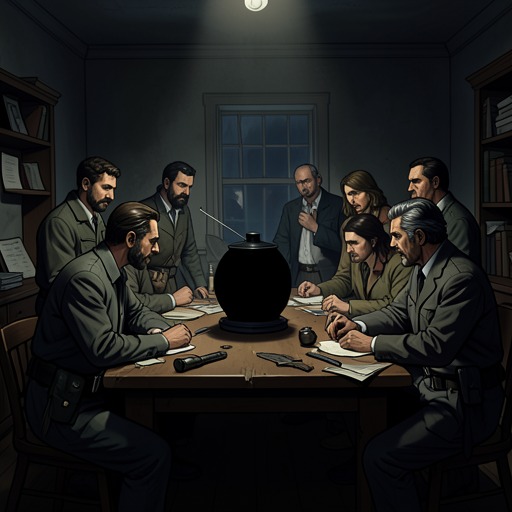
When a wrapped parcel is opened in Spade’s office, the figure inside matches that description. Under layers of brown paper, three sheets of coarse grey paper, and tightly packed excelsior, Spade finds a foot-high bird, black and glossy where dust has not dulled its polish. Its arrival turns the object from an account offered by interested parties into something present and apparently recoverable. Spade’s delighted response, and the excitement of those gathered around it, show how readily its physical presence seems to confirm their hopes.
The Promised Reward and the Pursuit
Joel Cairo offers five thousand dollars for the statuette’s recovery, claiming to act on behalf of its rightful owner and promising that no questions will be asked. The payment is substantial, but the offer also advertises how much depends on recovering the figure: Cairo seeks to make the transaction seem simple even as his careful wording leaves the object’s ownership unresolved.
Brigid describes the figure as something she was recruited to help obtain from a Russian named Kemidov. She says she had been promised five hundred pounds for her assistance; after she and Floyd Thursby had left Joel, Thursby offered her seven hundred and fifty. She refuses to explain how the object was to be taken, keeping the practical details outside Spade’s knowledge. Her account establishes a chain of competing interests rather than a straightforward recovery for an uncontested owner.
Spade’s conversations repeatedly bring the object back into the foreground. When Casper Gutman invites him to talk, Spade redirects the conversation to the black bird. He also declines to say plainly whether he is acting as Brigid’s representative, answering that the matter depends. The Falcon’s value is therefore not simply a sum attached to it: it becomes the subject around which Spade tests what the people seeking it know, want, and are prepared to disclose.
Gutman’s History of the Falcon
Gutman presents the bird as a jeweled tribute with a history reaching back to the Knights Hospitaller. In his account, the Knights, made wealthy by their campaigns and spoils, received Malta from Emperor Charles and were expected to provide an annual bird as rent. For the first year’s tribute, they supposedly commissioned not a live bird but a golden falcon covered in fine jewels, intended for Charles in Spain. Gutman says that Grand Master Villiers de l’Isle-Adam had the foot-high figure made by Turkish slaves at the castle of St. Angelo.
The reported journey is a succession of transfers and losses. Gutman says a galley carrying the gift never reached Spain: the corsair admiral Khair-ed-Din, known as Barbarossa or Redbeard, took the ship and the bird to Algiers. He invokes a letter by Pierre Dan as evidence that the figure remained there for more than a century, after which it was supposedly carried away by Sir Francis Verney. Gutman acknowledges a gap in this account: Lady Francis Verney’s memoirs say nothing about the bird, and he says Verney did not have it when he died in a hospital in Messina in 1615. Even so, Gutman maintains that the falcon went to Sicily, passed into the possession of Victor Amadeus II, and became a wedding gift to his wife after the king abdicated. He presents archival references and published histories as support, while insisting that his version is history despite its absence from ordinary schoolbooks.
The story’s grandeur stands in deliberate contrast to the figure’s later appearance. Gutman says that Charilaos had the bird re-enameled while researching its history, apparently giving it the black finish it now seems to possess. Seventeen years before his account to Spade, Charilaos’s establishment was burglarized and he was murdered; the bird disappeared with other stolen property. Gutman initially supposes that a thief who did not know the figure’s value took it as part of the loot. He argues that someone who understood its worth would have chosen no lesser prize alongside it than crown jewels.
Gutman says it took him seventeen years to locate the Falcon. He traced it to the home of General Kemidov, in a suburb of Constantinople. Kemidov, according to Gutman, regarded it as nothing more than a black-enamelled figure and refused to sell it when Gutman made an offer. Concerned that the general might investigate the object or chip away its enamel, Gutman sent agents to take it. They obtained the bird, but Gutman says he did not: it passed out of his possession and remained the object of his continuing pursuit. His account makes the very uncertainty that surrounds the Falcon part of its allure, while also explaining why the promise of finding it does not settle who can claim it.
Recovery and the Test
The parcel’s arrival produces an apparent turning point. Once Spade cuts its cord and removes the wrapping, the black bird looks like the object described by Cairo, Brigid, and Gutman. Spade declares that they have the thing, then lifts it and examines it in triumph. The scene converts a long chain of offers, stories, and missing property into a visible object that seems to meet everyone’s expectation.
Gutman’s reaction gives the recovery its emotional weight. When Spade brings the parcel to the table, Gutman opens it and holds the bird, greeting it as the object he has wanted for seventeen years. Cairo and Brigid watch as he sets it down and takes out a gold pocket-knife to test it. The others gather close, while Spade keeps himself positioned to watch Wilmer as well as the group. The figure’s possession is still precarious: even in the moment of apparent success, it has to withstand a test.
That test overturns the apparent resolution. Gutman scrapes the base, and black enamel comes away to reveal blackened metal. His knife removes a thin shaving whose exposed surface and the cut beneath it have the soft grey sheen of lead. He then hacks at the head and finds lead there too. Gutman calls the bird a fake. The distinction is decisive: the statuette is physically real and visually convincing, but it is not the jeweled historical Falcon promised by Gutman’s account.
Aftermath and Significance
The discovery changes the meaning of the recovered object without making it disappear. Until the knife breaks through the enamel, the bird seems to unite the seekers’ separate accounts and desires. Once its lead core is exposed, that seeming agreement collapses. Gutman’s long pursuit has brought him to a figure that cannot satisfy the value he assigned to it, and Spade’s moment of possession gives way to a new demand for an explanation from Brigid. The fake’s exposure therefore redirects the scene from possession to responsibility: Spade takes hold of Brigid’s wrist and asks her to tell what happened.
Gutman leaves the rejected figure on the table as a parting memento. His farewell to Brigid explicitly makes the object a keepsake, a pointedly diminished role for the prize he has pursued for seventeen years. The statuette’s changing status—from tribute, to stolen treasure, to promised recovery, to apparent possession, to counterfeit, and finally to memento—compresses the story’s recurring gap between a coveted object and the claims made on its behalf. The Falcon’s lead interior does not erase the force it exerted; it reveals how that force had been sustained by expectation, secrecy, and belief.